
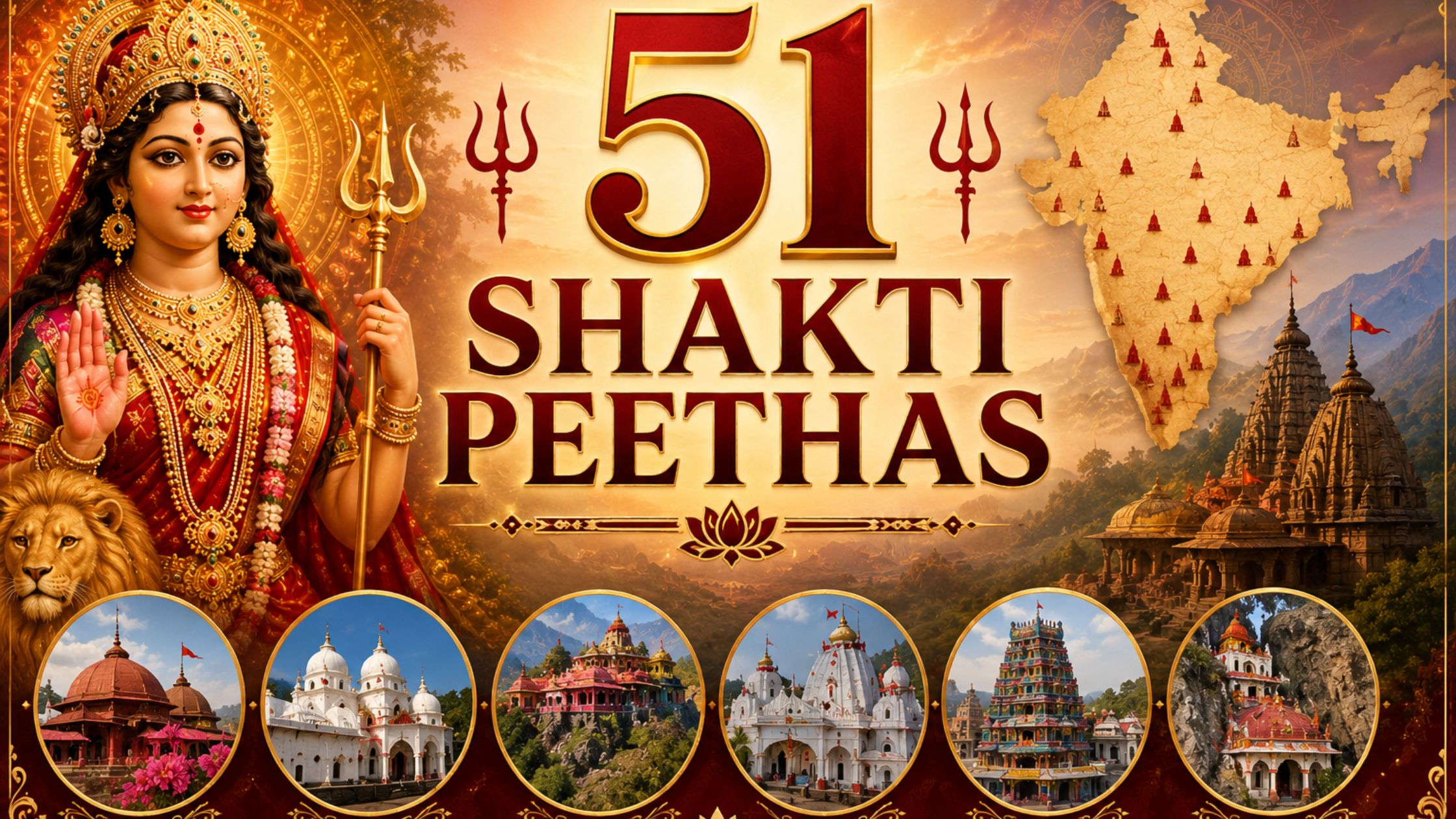
The 51 Shakti Peethas are among the most sacred pilgrimage destinations in Hinduism. These holy temples dedicated to Goddess Shakti represent divine feminine energy, spiritual strength, devotion, and cosmic power. Spread across India and neighboring countries, the Shakti Peethas attract millions of devotees seeking blessings, peace, and spiritual awakening.
The story of the Shakti Peethas is deeply connected to Goddess Sati and Lord Shiva. These sacred sites are not only important religious destinations but also symbols of India’s spiritual and cultural heritage.
This complete guide explores the origin, mythology, significance, rituals, and full list of the 51 Shakti Peethas.
The Origin of the 51 Shakti Peethas
According to Hindu mythology, Goddess Sati was the daughter of King Daksha Prajapati and the devoted wife of Lord Shiva.
King Daksha strongly disapproved of Shiva and organized a grand yajna while intentionally refusing to invite Shiva and Sati. Despite this insult, Sati attended the ceremony hoping to maintain peace with her family.
At the yajna, Daksha publicly insulted Lord Shiva. Unable to tolerate the humiliation of her husband, Goddess Sati sacrificed herself in the sacred fire.
When Shiva learned about Sati’s death, he was overwhelmed with grief and anger. Carrying Sati’s body, he performed the Tandava, the cosmic dance of destruction.
To restore balance in the universe, Lord Vishnu used his Sudarshan Chakra to divide Sati’s body into pieces. These body parts fell at different places across the Indian subcontinent, and each location became a sacred Shakti Peeth.
Read more: India’s Most Searched Spiritual Cities
Why Are There 51 Shakti Peethas?
The number 51 is believed to represent the 51 sacred body parts and ornaments of Goddess Sati that fell across different regions. Each Shakti Peeth is associated with a specific body part, ornament, or divine energy manifestation of the Goddess.
Every temple also has a corresponding Bhairava form of Lord Shiva, representing the inseparable connection between Shiva and Shakti. This spiritual union symbolizes the balance of masculine and feminine cosmic energies.
Many ancient scriptures, including the Tantra Chudamani and Devi Bhagavata Purana, describe these sacred sites in detail. Over time, these temples became important pilgrimage centers for devotees seeking blessings, protection, spiritual growth, and inner peace.
Spiritual Importance of the Shakti Peethas
The Shakti Peeths are believed to radiate divine feminine energy. Devotees visit these temples to:
- Seek blessings and protection
- Gain spiritual peace
- Remove negative energy
- Achieve emotional healing
- Strengthen devotion and faith
Each Shakti Peeth represents a unique manifestation of Maa Shakti and is associated with a Bhairava form of Lord Shiva.
Complete List of the 51 Shakti Peethas
| No. | Shakti Peeth | Location | Body Part of Sati | Goddess Form |
| 1 | Kamakhya Temple | Assam | Yoni | Kamakhya |
| 2 | Kalighat Kali Temple | West Bengal | Toes | Kali |
| 3 | Jwala Ji Temple | Himachal Pradesh | Tongue | Siddhida |
| 4 | Naina Devi Temple | Himachal Pradesh | Eyes | Naina Devi |
| 5 | Hinglaj Mata Temple | Pakistan | Head | Hinglaj Mata |
| 6 | Tara Tarini Temple | Odisha | Breasts | Tara Tarini |
| 7 | Vishalakshi Temple | Uttar Pradesh | Earrings | Vishalakshi |
| 8 | Kanyakumari Temple | Tamil Nadu | Back | Kanyakumari |
| 9 | Ambaji Temple | Gujarat | Heart | Ambaji |
| 10 | Chamundeshwari Temple | Karnataka | Hair | Chamundeshwari |
| 11 | Mangalagauri Temple | Bihar | Breast | Mangalagauri |
| 12 | Mahalakshmi Temple | Maharashtra | Eyes | Mahalakshmi |
| 13 | Biraja Temple | Odisha | Navel | Biraja |
| 14 | Sugandha Shakti Peeth | Bangladesh | Nose | Sunanda |
| 15 | Attahas Shakti Peeth | West Bengal | Lips | Phullara |
| 16 | Bakreshwar Temple | West Bengal | Mind | Mahishamardini |
| 17 | Kankalitala Temple | West Bengal | Waist | Devgarbha |
| 18 | Nalhati Shakti Peeth | West Bengal | Throat | Nalateshwari |
| 19 | Ujani Shakti Peeth | West Bengal | Wrist | Mangal Chandika |
| 20 | Bahula Shakti Peeth | West Bengal | Left Arm | Bahula |
| 21 | Kiriteswari Temple | West Bengal | Crown | Kiriteswari |
| 22 | Ratnavali Shakti Peeth | West Bengal | Right Shoulder | Kumari |
| 23 | Yogadya Temple | West Bengal | Toe | Yogadya |
| 24 | Trisrota Shakti Peeth | West Bengal | Left Leg | Bhramari |
| 25 | Kal Madhav Temple | Madhya Pradesh | Left Buttock | Kali |
| 26 | Maihar Devi Temple | Madhya Pradesh | Necklace | Sharda |
| 27 | Mahur Renuka Temple | Maharashtra | Right Hand | Renuka |
| 28 | Saptashrungi Temple | Maharashtra | Right Arm | Saptashrungi |
| 29 | Tulja Bhavani Temple | Maharashtra | Right Shoulder | Bhavani |
| 30 | Sharada Peeth | Kashmir | Right Hand | Sharada |
| 31 | Chintpurni Temple | Himachal Pradesh | Feet | Chintpurni |
| 32 | Mansa Devi Temple | Uttarakhand | Head Ornament | Mansa Devi |
| 33 | Vindhyavasini Temple | Uttar Pradesh | Anklet | Vindhyavasini |
| 34 | Devi Patan Temple | Uttar Pradesh | Shoulder | Pateshwari |
| 35 | Bhadrakali Temple | Haryana | Ankle | Bhadrakali |
| 36 | Tripura Sundari Temple | Tripura | Right Foot | Tripura Sundari |
| 37 | Jayanti Shakti Peeth | West Bengal | Left Thigh | Jayanti |
| 38 | Vimala Temple | Odisha | Navel | Vimala |
| 39 | Kireetkona Temple | West Bengal | Crown | Vimala |
| 40 | Bhuteshwari Temple | Bangladesh | Left Hand | Aparna |
| 41 | Jessoreswari Kali Temple | Bangladesh | Palms | Jessoreswari |
| 42 | Chandranath Temple | Bangladesh | Right Arm | Bhavani |
| 43 | Kumari Amman Temple | Tamil Nadu | Spine | Devi Kumari |
| 44 | Meenakshi Temple | Tamil Nadu | Eyes | Meenakshi |
| 45 | Srisailam Temple | Andhra Pradesh | Neck | Bhramaramba |
| 46 | Draksharamam Temple | Andhra Pradesh | Left Cheek | Manikyamba |
| 47 | Kanchi Kamakshi Temple | Tamil Nadu | Navel | Kamakshi |
| 48 | Jogulamba Temple | Telangana | Teeth | Jogulamba |
| 49 | Mahakaleshwar Area Harsiddhi Temple | Madhya Pradesh | Elbow | Harsiddhi |
| 50 | Kalasubai Devi Shrine | Maharashtra | Finger | Kalasubai |
| 51 | Lankeshwari Temple | Sri Lanka | Anklet | Indrakshi |
Importance of Navratri at Shakti Peeths
Navratri is one of the most important festivals celebrated at Shakti Peeths. During these nine sacred nights:
- Temples are decorated beautifully
- Special aartis and yajnas are performed
- Thousands of devotees gather for worship
- Cultural and devotional programs are organized
The festival celebrates the victory of divine energy over evil forces.
The Cultural Influence of Shakti Peethas
The influence of the Shakti Peethas extends beyond religion. These temples have shaped Indian art, music, architecture, literature, and spiritual traditions for centuries.
Ancient temple carvings, devotional songs, and regional festivals often revolve around the stories of Goddess Shakti. Navratri celebrations across India especially highlight the importance of the Goddess and her divine forms.
The Shakti Peeths also play a major role in promoting spiritual tourism. Pilgrims visiting these sacred destinations contribute to preserving local traditions, crafts, and temple heritage.
Mysteries and Legends Surrounding the Shakti Peethas
Many Shakti Peethas are surrounded by fascinating mysteries and miracles. Some temples are believed to possess supernatural energy, while others are associated with unexplained phenomena.
For example, the eternal flames at Jwala Ji Temple continue to burn naturally, attracting both devotees and researchers. Similarly, ancient rituals performed at various temples are believed to bring healing, peace, and spiritual transformation.
These legends continue to strengthen the faith of devotees and add to the sacred aura of the temples.
Why Devotees Visit the Shakti Peethas
Millions of devotees visit these temples for:
- Spiritual awakening
- Emotional healing
- Family blessings
- Success and prosperity
- Protection from negativity
- Peace and devotion
The spiritual atmosphere of these temples creates a deep connection between devotees and Maa Shakti.
Conclusion
The 51 Shakti Peethas are not just temples—they are timeless symbols of divine feminine energy, faith, sacrifice, and spiritual transformation. Their origin story reflects the eternal bond between Shiva and Shakti and continues to inspire millions of devotees around the world.
From ancient legends and sacred rituals to powerful spiritual vibrations, these holy sites remain among the most important pilgrimage destinations in Hinduism. Exploring the history and significance of the 51 Shakti Peethas offers a deeper understanding of India’s spiritual heritage and the everlasting power of Maa Shakti.
Learn more: Bhavishyamalika